

Interventional Neuroradiology Research Group
Interventional Neuroradiology has emerged as an important discipline in the treatment of cerebrovascular diseases such as ischemic stroke and vascular malformations (e.g., aneurysms or AVMs). Continuous technological innovation and the development of new minimally invasive therapeutic procedures and devices have been key to the advancement of neurointerventional techniques. Through close scientific and technical collaboration with medical device manufacturers and the conduct of single- and multi-center studies, we are able to examine these techniques in their entirety and discuss modifications and improvements to the devices with the manufacturers. This translational research approach allows us to investigate the scope and efficacy of new products, as well as to better understand their limitations and complication profiles. The infrastructure of our department also allows us to seamlessly integrate the knowledge gained into clinical practice, continuously expanding the range of neurovascular interventions, making them safer to perform and improving outcomes.
Our research focuses on the endovascular treatment of ischemic stroke and intracranial aneurysms. For example, our research has helped establish intrasaccular flow disruptors (e.g., Woven EndoBridge, WEB device) as one of the primary treatment options for intracranial aneurysms at our institution. As a result, more and more aneurysms that previously could only be treated with open clip surgery can now be treated minimally invasively. This technique has also proven to be less complicated and more effective than other endovascular treatment methods.
The current focus is on clinical research into surface coatings on flow-diverter stents. These coatings have the potential to minimize complications by inhibiting platelet aggregation on the stent surface. The clinical potential of these coatings is currently being evaluated in a multi-center study.
- Center of Neurosurgery, University Hospital Cologne, Germany
- Department of Neurology, University Hospital Cologne, Germany
- Department of Neuroradiology, University Hospital Munich (LMU), Germany
- Department of Neuroradiology, University Hospital Berlin, Germany
- Department of Neuroradiology, University Hospital Heidelberg, Germany
- Department of Neuroradiology, University Hospital Aachen, Germany
- Institute for Diagnostic and Interventional Radiology and Neuroradiology, University Hospital Essen, Germany
- Department of Neuroradiology, University Hospital Bonn, Germany
- Department of Neuroradiology, University Hospital Düsseldorf, Germany
- Institute for Diagnostic Radiology, Neuroradiology and Nuclear Medicine, Johannes Wesling Klinikum Minden, Germany
- Department of Interventional Radiology and Neuroradiology, Klinikum Hochsauerland, Arnsberg, Germany
- Department of Neuroradiology, Städtisches Klinikum Solingen, Germany
Principal investigators



Group Members
Prof. Dr. Marc Schlamann
Dr. Jonathan Kottlors
Priv.-Doz. Dr. Lenhard Pennig
Thomas Schömig
Priv.-Doz. Dr. Michael Schönfeld
Image gallery
⠀
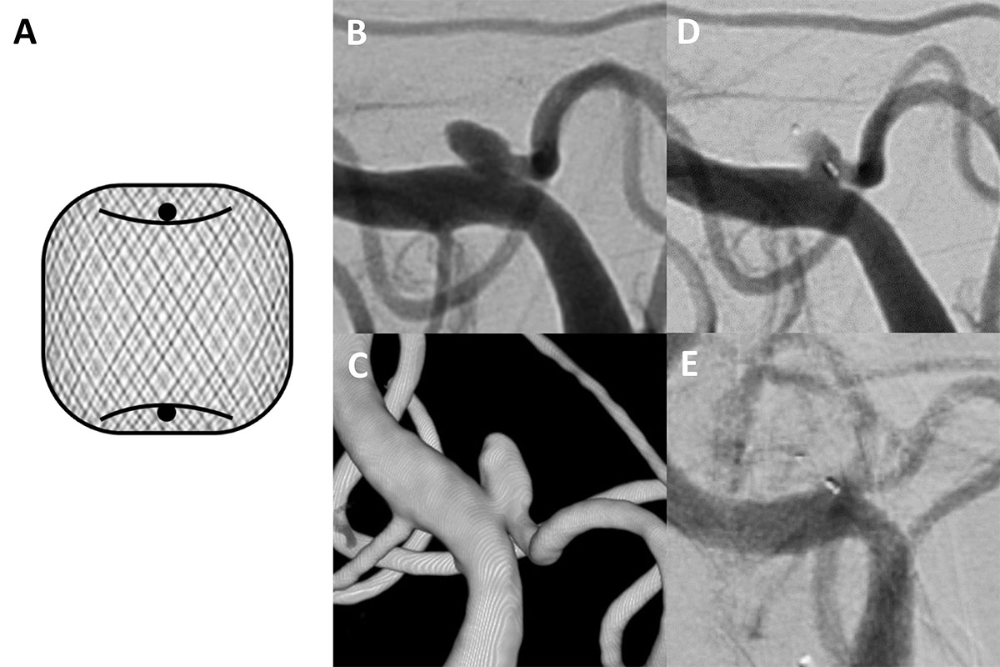
Abbildung 1 Foto: N.A.
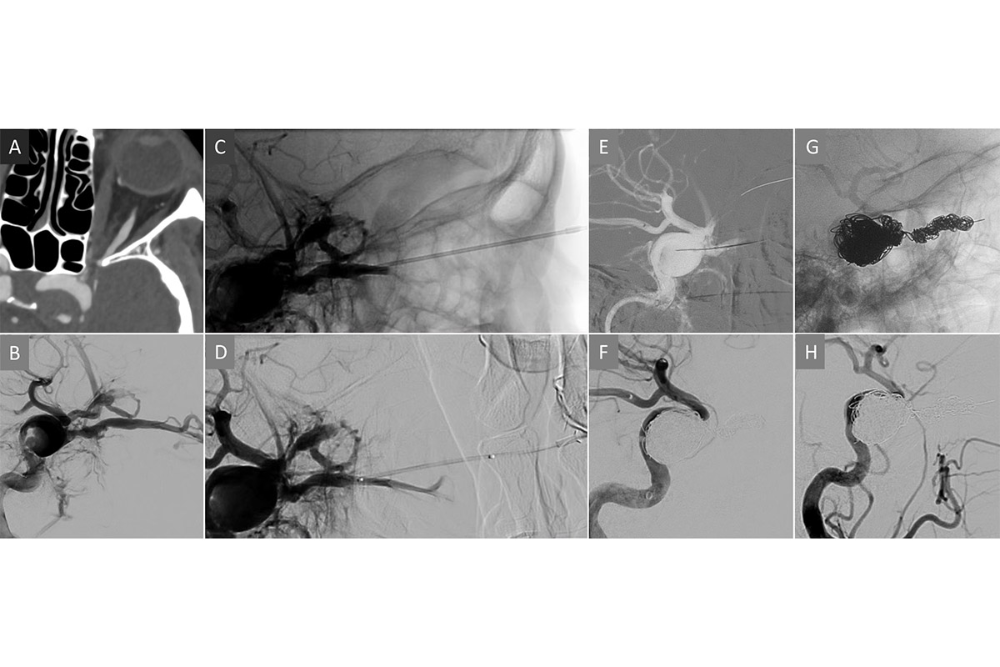
Abbildung 2 Foto: N.A.
Aneurysms of the proximal posterior inferior cerebellar artery (PICA) are difficult to treat both endovascularly and by clipping due to their often wide neck, the small caliber of the PICA, and their proximity to the brainstem with brainstem perforators. Intrasaccular flow-disruptors such as the Woven EndoBridge (WEB) are spherical devices that are placed completely inside the aneurysm sac and seal the aneurysm neck (A). They are particularly suitable for the endovascular treatment of wide-neck and bifurcation aneurysms. Due to their shape, they are also potentially suitable for treating PICA aneurysms, especially with the miniaturized, low-profile WEB 17 system. The advantage of the WEB is that it allows treatment of small and wide aneurysms while leaving the parent vessels and brainstem perforators patent; however, this application has not yet been established. In a pilot study of 16 cases, we showed that WEB treatment of PICA aneurysms is feasible with a technical success rate of 94%, a low morbidity rate of 6%, and complete and adequate occlusion rates of 80% and 100% at midterm, respectively. The figure shows digital subtraction angiography (B) and 3D rotational angiography (C) images of a ruptured aneurysm at the proximal PICA (2.7 mm). Treatment with coiling alone would not have been feasible due to the wide neck, and stent implantation would have been cumbersome due to the small vessel diameter and location at the PICA bifurcation. The smallest available WEB SL (3x2 mm) was implanted with the WEB 17 system, perfectly sealing the aneurysm at the neck (D). At the 3-year angiographic follow-up, the aneurysm is completely occluded (E).
The presented case describes a combined transarterial and inferior ophthalmic vein approach to a direct carotid-cavernous fistula, an uncommon neurointerventional approach to treat these fistulas that became necessary due to individual anatomical limitations as described below. The detailed description of this technique has been published in a technical note. Computed tomography angiography shows a partially thrombosed cavernous internal carotid artery aneurysm and an arterialised and engorged inferior orbital vein (IOV; A). Digital subtraction angiography (DSA) confirms the diagnosis of a direct high-flow carotid-cavernous fistula (CCF) caused by perforation of the aneurysm into the cavernous sinus. DSA also shows extensive retrograde filling of the enlarged IOV and less pronounced retrograde filling of the partially thrombosed superior ophthalmic vein (B). Attempting a combined transvenous and transarterial approach for endovascular fistula embolization, microcatheter probing of the IOV via the facial vein failed due to extensive vessel tortuosity. Therefore, after a small skin incision on the medial aspect of the lower eyelid, direct puncture of the IOV was performed with an 18G venous cannula. The cannula was advanced stepwise to the IOV under repeated biplane roadmap guidance in two planes (C). After successful puncture, a low profile microcatheter was advanced over the needle to the CCF (D) and into the aneurysm dome (E). Via the arterial catheter, a protective flow diverter (Pipeline Vantage 5.5x20 mm) was implanted in the internal carotid artery over the aneurysm neck (not shown). Then the aneurysm and CCF were completely occluded with coils (F+G). At the 1-month follow-up, the CCF remained completely occluded (H).