
Diagnostic and Interventional Computer tomography
Everything you need to know about the examination.
Computed tomography (CT) is one of the most important diagnostic tools in modern radiology. It allows highly detailed cross-sectional images of the body to be obtained. This makes it possible to reliably detect structural changes such as fractures, bleeding, bruising, swelling, and often inflammatory processes.
State-of-the-art CT technology for precise diagnosis
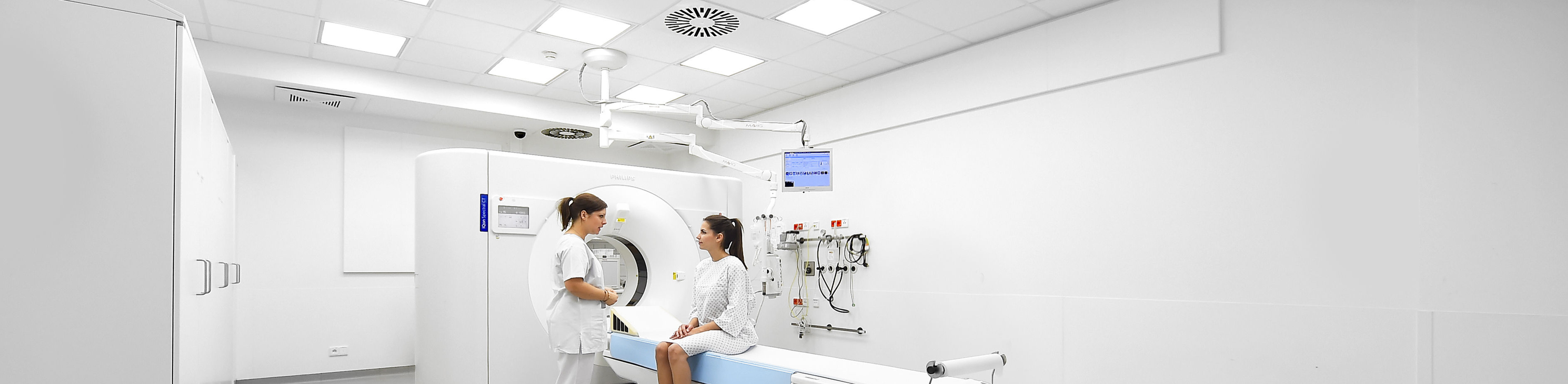
Our clinic is equipped with some of the most modern CT systems available, including two advanced spectral CT scanners. These systems provide exceptionally precise diagnostics, as they can differentiate tissues, contrast agents and material compositions far more accurately than conventional CT scanners.
Specialised CT diagnostics for specific clinical questions
Our modern equipment enables us to perform specialised CT examinations, including:
- Detection or exclusion of gout by visualizing uric acid crystals
- Cardiac CT for assessment of coronary arteries and cardiovascular risk
- Optimized oncological imaging
These extended diagnostic capabilities help detect diseases early and reliably.
CT-guided interventions
A key part of our work involves CT-guided, minimally invasive procedures, which can be performed with high precision and safety, including:
- Tissue sampling (biopsies)
- Placement of drainages to relieve or remove fluid collections
- Preoperative or radiotherapy marker placement
- Thermal ablation procedures (e.g., cryoablation or microwave ablation)
These procedures often allow treatment without major surgery, with short recovery times and a high level of safety. Whether thermal ablation is the best option for you is always decided interdisciplinarily. In tumour board meetings, radiology, surgery, oncology, gynaecology, urology, pathology and other specialties jointly determine the best approach for each individual patient.
Frequently asked questions
How should I prepare for the examination?
For a routine CT scan, you do not need to be fasting.
Please inform us about previous contrast agent reactions
If you have ever had an allergic reaction or intolerance to a CT contrast agent (e.g., rash, breathing difficulties, circulatory reactions), please inform us already when booking your appointment. This information is essential for planning your examination safely and taking preventive measures if necessary.
Important blood tests before a CT scan with contrast agent
If your examination requires contrast agent, please bring recent creatinine and TSH laboratory values.
These should be obtained about one week before the appointment by your general practitioner or referring physician.
They provide important information about your kidney and thyroid function, which is necessary for your safety during the examination.
During the pre-exam consultation, our radiologists will ask you to present these values.
Without them, we unfortunately cannot perform the examination safely due to potential risks to the kidneys and thyroid.
If any of the values are abnormal, please inform us early so we can plan any necessary adjustments.
Please bring previous imaging studies
If you have had radiological examinations performed outside our hospital (CT, MRI, X-ray, ultrasound), please bring them on CD, USB stick, or via QR code. A comparison with previous studies is extremely important for radiologists to:
- assess whether findings have changed over time
- evaluate if treatments are working
- detect new abnormalities
Without prior imaging, the diagnostic assessment may be limited.
How does the examination work?
1. Pre-examination consultation
Before the scan, a radiologist will explain the benefits and potential risks of the CT examination. You will receive a patient information sheet. Please read it carefully and fill it out completely.
Any questions you have can be discussed during the consultation.
2. Contrast agent – what you need to know
When is contrast agent used?
Many CT scans require intravenous contrast to better visualize organs and blood vessels.
Tolerance and safety
Contrast agents are generally very well tolerated. Rarely, side effects may occur, such as:
- Allergic reactions
- Impaired kidney function
- Impaired thyroid function
The risk is significantly reduced by checking current laboratory values (creatinine, TSH).
Important: Allergies
If you have had an allergic reaction or intolerance to contrast agent in the past, please inform us when scheduling your appointment.
How is contrast administered?
A small intravenous line is placed on your arm or the back of your hand—similar to a blood draw. The contrast agent is administered via an automated injector during the scan. A brief warm sensation throughout the body is normal and harmless.
3. During the examination
Positioning
You will lie on the examination table. For chest or abdominal scans, your arms need to be raised above your head.
The scan
The table will move gently into the CT scanner. Our modern scanners have a wide opening, so claustrophobia is typically not an issue. The actual CT scan takes only a few seconds.
4. After the examination
- Your images are available immediately via QR code or with a short waiting time on CD/DVD.
- If you would like a personal discussion of the results with a radiologist, please allow some additional time for image interpretation.
Accessing images and reports digitally
After your examination, your images can be accessed via QR code or access code on a mobile device or computer.
Your treating physician can also view the images and discuss them with you.
The written report is available within a few hours through our online portal.
It is also sent to your referring physician by mail.
Simply scan the QR code you receive from us or enter your access code in the University Hospital Cologne image portal.
For detailed instructions, please see our Flyer for the Online Web Viewer.
Further information
- Information on our areas of focus
- Technical details about the equipment of our institute
- Find out more about computed tomography research at our institute here