
Pulse-synchronous ear noise / dural fistulas
If you have been diagnosed with a pulse-synchronous ringing in the ears or dural fistulas, you are welcome to register for a consultation in the neuroradiology department using the contact details below. Links for referring physicians, consultation requests, etc. can be found at the bottom of the page.
Contact
Appointments Office
Tuesdays and Thursdays from 09:00 - 12:00
Phone +49 221 478-82035
E-mail neuroradiologie@uk-koeln.de
Building 18a Site plan
Frequently asked questions
Many people suffer from ringing in the ears. This can occur in the form of a whistling noise, but also as a noise synchronized with the heartbeat. The latter can have many causes. These range from short-circuit connections between arteries and veins (fistulas) to benign but well-perfused tumors in the middle ear (paraganglioma) to narrowing of the carotid artery.
A common cause is a so-called "dural fistula". These are short-circuit connections between arteries and veins, usually on the skull bone behind the ear but also in other parts of the head. In some cases, the cause may be an accident or cerebral venous thrombosis.
In most cases, an MRI is sufficient to detect/exclude causes that require treatment or can be treated. However, this MRI should be performed by experienced neuroradiologists with certain technical requirements and examination sequences. In most cases, an MRI is sufficient to detect/exclude causes that require or can be treated. However, this MRI should be performed by experienced neuroradiologists with certain technical requirements and examination sequences.
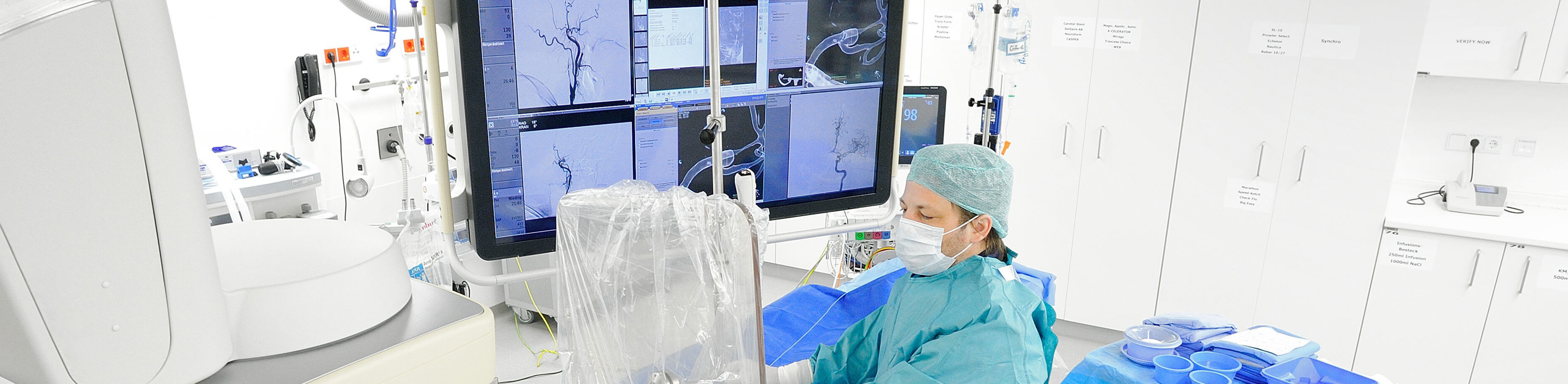
Dural fistulas are usually easy to treat neuroradiologically, but this is not always necessary. Only if there is a backflow of blood to the brain does treatment become mandatory from a medical point of view, as there is a risk of cerebral hemorrhage. A catheter angiography is the best way to determine whether such a backlog exists.
If you have a pulse-synchronous ear murmur or a suspected dural fistula, you are welcome to make an appointment for a consultation.