
Frequently asked questions
MR-TULSA(transurethralultrasoundablation ofthe prostate) is a new method and gentle alternative to surgical treatment. The treatment combines magnetic resonance imaging (MRI) and high-energy ultrasound waves (TULSA). Ultrasound waves and MRI have been successfully used individually for many years. The combination of both methods has opened up new treatment options, which are partly due to the improved imaging capability of MRI. Until now, MR ultrasound wave HIFU has mainly been used to treat uterine fibroids. Recently, MR-TULSA therapy can also be used to ablate (destroy by heat) prostate tissue in patients with localized "low-risk" and "intermediate-risk" prostate cancer (PCa). The University Hospital of Cologne is one of the few TULSA-PRO®, Profound Medical Centers in Europe.
In general, there is a certain risk of prostate cancer remaining after the procedure due to the new focal MR-TULSA technique. To minimize this risk, a high-quality multiparametric MRI (mpMRI) of the prostate should be performed prior to the prostate biopsy. The biopsy should then be performed as an MR ultrasound fusion biopsy(BiopSee® MRI-guided prostate punch biopsy). There is also a risk of recurrence of prostate cancer after the procedure in the untreated parts of the prostate.
The tumour should belong to the low-risk to intermediate-risk class (Gleason 3+3=6 or 3+4=7a), be focally located in the middle area of the prostate and be confined to the prostate gland (cT1/T2).
The following treatment options are generally available for this localized disease in accordance with the German guidelines:
- Total surgery (radical prostatectomy)
- External or internal radiation (percutaneous or brachytherapy)
- Active surveillance of low-risk tumors (active surveillance)
However, there is no gold standard for all patients; the respective treatment is always determined in a personal consultation and on the basis of the patient's individual parameters.
In general, your histological biopsy results after a prostate cancer diagnosis should be discussed in a personal consultation with a urologist at Cologne University Hospital to see whether focal MR-TULSA therapy can also be considered.
Patients should always discuss in advance with the responsible urologist and/or radiologist to what extent MR-TULSA treatment is possible and appropriate, in particular MR-TULSA treatment does not appear suitable in the case of
- aggressive and/or multifocal prostate carcinoma (Gleason score ≥ 7b and/or clinical tumor stage ≥ cT3)
- Metal parts in the body (pacemaker, etc.)
- Allergies or contraindication to Buscopan
- Obstructive urination problems
- previous operations on the urethra, prostate or bladder
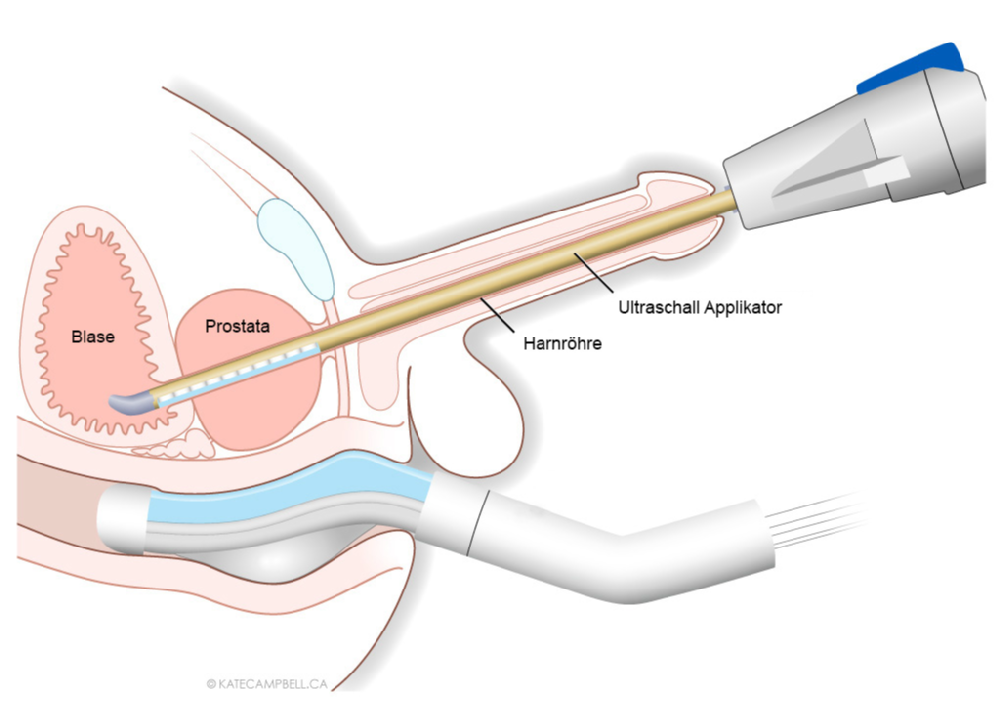
TULSA therapy is a non-invasive treatment method. The high-intensity ultrasound waves heat and irreversibly damage the prostate tissue in the body without damaging the surrounding tissue. The narrow ultrasound applicator inserted into the urethra generates ultrasound waves that can heat and destroy the prostate tissue in the area of the prostate carcinoma in a controlled manner.

What happens after MR-TULSA treatment?
After 12 months, a single MRI of the prostate and a transperineal MR ultrasound fusion biopsy of the prostate are performed again. This is done to determine the structural prostate changes caused by the ablation and to ensure that the tumor has been fully treated. If the biopsy is inconspicuous, further oncological care is then provided by the urologist in private practice.
Further information
- Read more about our equipment here
- Interventional radiology and MR-HIFU as a focus at the institute
- Research in experimental imaging and interventional radiology